 Sergio Carracedo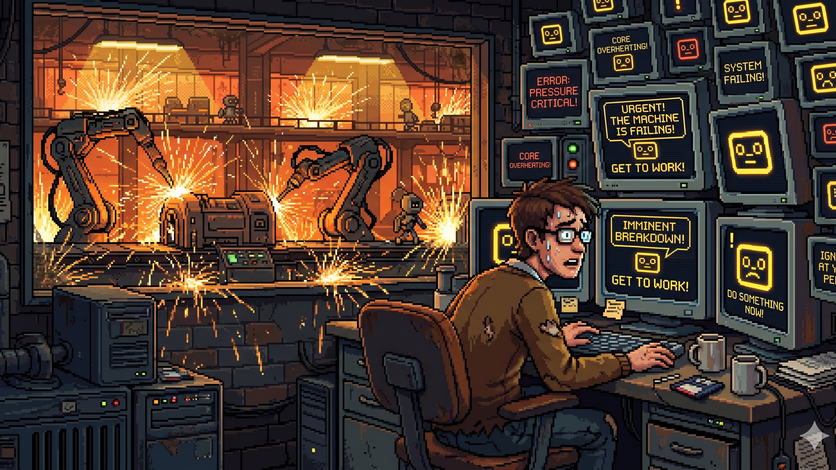
This article was originally published in Fika.
A few years ago (more than I’d like to admit), I worked at the Citroën factory in Vigo, in the body shop (where the parts that make up the vehicle chassis are welded). I worked on the M49 line (the first Berlingo/Partner), in various positions, but mainly on the rear platform side members, where the shock absorbers and the rear axle are attached.
The work in the body shop mainly consisted of placing the parts to be joined in specific positions on a jig; once placed, the jig was closed, where pneumatic clamps held all the parts so they wouldn’t move during the welding process, and then with a resistance welding gun, spots were welded in the designated locations for each part; once finished, the jig was opened and the part was passed to the next station.
Something similar to the video above (but with much more rhythm 😅)
This was a purely manual station, but there were also robot feeding stations, where the operator mounted the parts on the jig (actually there were two, so that while the robot was welding, you could prepare the next part) and once done, with a confirmation button, the jig closed, rotated, and passed to the robot that welded it.
At first glance, it seems both positions are the same, except that in the second case, there is a robot in charge of welding; however, there is one detail that makes these two positions very different. In the purely manual position, the operator (or operators, as there could be several), as humans, have the ability to “sprint,” so it was common at times to speed up the production pace (until filling the queue for the next station) to have a bit more time for a snack break, to go to the bathroom, or whatever was needed.
In a collaborative position with a robot, it always moved at the same pace; if you were late mounting a part (because, for example, the restock hadn’t arrived on time), it had to wait, and then it couldn’t recover that time by “rushing.” This put a lot of tension and pressure on the machine operator, as time is money, especially in a factory.
This is exactly what I’m seeing in my day-to-day with AI Software Engineering. With manual coding, we can have different rhythms at any given moment depending on how ideas flow, distractions, etc., but we have the capacity to adjust (at least a little and for a period of time) that pace—for example, by setting a focus time on Slack to be 100% concentrated on the task.
When I work with coding agents, my feeling is identical to that of the robot collaboration stations: if the agent stops to ask a question, every second you take to respond is time the agent loses and that won’t be recoverable.
This generates a feeling of continuous anxiety, with the added complication that you don’t know if the agent will ask something every 34 seconds like the robot; it can ask at any moment, so you have to be very attentive while doing other tasks, compounded by the continuous context switching.
This is a very large paradigm shift that we will have to deal with, but I believe identifying it is a step forward.
What helps me is having a mental map of the projects or tasks I’m doing and what phase each one is in. Additionally, I’m now starting to jot down ideas that occur to me for each project/task for the next iteration with the agent.
I would like to hear about your experience:
- Had you noticed this pattern of anxiety generated by working with agents?
- How does it affect you?
- How are you managing it?
- Do you think it’s sustainable over time?
